
The 2026 Checklist for Selecting Residential Home Builders in NYC
- ArGetsBuckets -
- Jul 22
- 11 min read

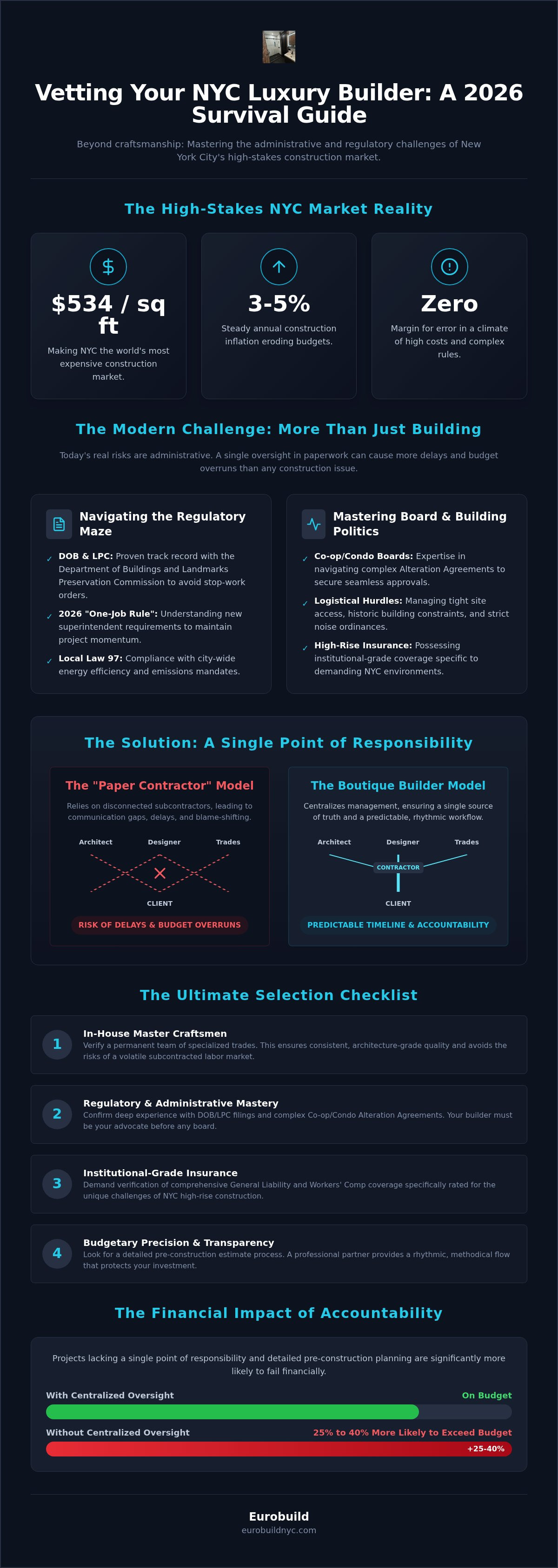
With New York City currently ranked as the most expensive construction market globally at an average of $534 per square foot, the margin for error in residential development has effectively vanished. In this high-stakes climate, your choice of a luxury general contractor nyc is no longer just a search for a builder. It's a search for a sophisticated project manager capable of navigating the 2026 "One-Job Rule" and the intricate demands of Local Law 97. You deserve a partner who treats administrative compliance with the same reverence as architectural-grade finishes.
We recognize the anxiety that stems from potential DOB stop-work orders or the quiet dread of a Co-op board rejection. These obstacles are real, and they are increasingly costly as annual construction inflation remains steady at 3 to 5 percent. This article provides a definitive vetting framework designed to master the complexities of modern NYC luxury construction. We'll explore how to identify a builder who offers a single point of accountability, a single source of truth, and a single path to a predictable timeline that holds firm against the city's shifting regulatory tides.
Table of Contents
Navigating the High-Stakes World of NYC Residential Home Building
New York City is currently the most expensive construction market in the world. With costs averaging $534 per square foot, the financial stakes for residential projects have never been higher. In 2026, the volatility of the Manhattan and Brooklyn markets demands more than just premium materials. It demands absolute accountability. While many firms claim the title of luxury general contractor nyc, few possess the administrative depth to navigate the city's current regulatory climate. Luxury is the baseline. Accountability is the true differentiator.
A boutique residential builder functions as a specialized project partner rather than a simple service provider. This role has shifted toward deep design-build integration. It's a method where master craftsmanship meets meticulous management. By bridging the gap between architectural intent and field execution, these firms eliminate the "blame game" that often plagues high-end renovations. You aren't just hiring a builder; you're securing a single point of responsibility for your most valuable asset.
The Complexity of the NYC Urban Environment
Building in NYC is a logistical feat. Historic townhouses and high-rise penthouses present constraints that standard contractors rarely encounter. You face tight site access, strict noise ordinances, and the constant friction between vision and structural reality. Senior-level oversight on every job site is mandatory. Without it, the "One-Job Rule" for superintendents and Local Law 97 compliance can quickly derail a project. Master builders anticipate these hurdles. They don't just react to problems. They engineer solutions before the first permit is filed.
Why a Single Point of Contact is Non-Negotiable
Fragmentation kills timelines. When communication breaks down between architects, designers, and trades, the client pays the price. A single point of contact ensures that responsibility is centralized. This general contractor model provides a single source of truth for the entire project. It streamlines the decision-making process and ensures that the original design intent isn't lost in translation during the construction phase.
Centralized management prevents communication gaps between specialized trades.
Single-source responsibility removes the risk of finger-pointing during complex installations.
Architecture-grade project management protects your financial investment from avoidable delays.
The financial benefits are clear. Projects without a pre-construction estimate or centralized oversight are 25% to 40% more likely to exceed their budgets. A professional partner provides a rhythmic, methodical flow to the work. They take full ownership of the outcome. This level of precision isn't just about the final finish. It's about the peace of mind that comes from knowing your project is in expert hands, moving forward with a predictable timeline despite the complexities of the NYC landscape.
The Ultimate Selection Checklist for Luxury Builders
In the high-stakes environment of Manhattan and Brooklyn residential construction, a builder’s administrative precision must match their physical craftsmanship. Selecting an elite luxury general contractor nyc requires a vetting framework that goes beyond aesthetic portfolios. You need a partner who understands that a single oversight in a Co-op Alteration Agreement can result in months of delays. This checklist serves as your definitive guide to identifying a firm capable of executing architecture-grade results under the city's strict 2026 regulations.
In-House Master Craftsmen: Verify that the firm employs a permanent team of specialized trades. This ensures consistent quality and removes the unpredictability of the volatile NYC labor market.
Regulatory Mastery: Confirm a proven track record with the NYC Department of Buildings (DOB) and the Landmarks Preservation Commission (LPC). This is critical for historic townhouse renovations.
Administrative Expertise: Ensure the builder has extensive experience navigating complex Alteration Agreements for premier high-rise buildings. They must act as your advocate before the board.
Institutional-Grade Insurance: Demand verification of comprehensive General Liability and Workers' Compensation coverage specifically rated for NYC high-rise environments.
Budgetary Precision: Look for transparency in the luxury home renovation cost NYC through detailed, line-item estimating. Vague "allowances" are a red flag for future cost overruns.
Reliability is built on a foundation of transparency. When you partner with an accountable builder, you eliminate the stress of hidden contingencies and communication gaps.
The Financial and Legal Vetting Process
Stability is non-negotiable for large-scale projects. Review the builder’s bonding capacity and financial history to ensure they can sustain a multi-year project without liquidity issues. Verify references for projects of similar scope. Ask specifically about their approach to change orders. A professional firm uses a methodical process for budget contingencies, ensuring that financial shifts are documented and justified rather than reactionary.
Operational Readiness and Scheduling
Modern NYC construction requires a robust technology stack. Your builder should utilize sophisticated project tracking software to provide real-time reporting on milestones and material procurement. With the 2026 "One-Job Rule" for licensed superintendents, you must assess the dedicated project manager’s bandwidth. Ensure they have the capacity for senior-level oversight on your job site every day. A localized supply chain for premium materials is equally vital. It prevents the logistical bottlenecks that frequently plague projects relying on unverified international shipping timelines.
Evaluating Craftsmanship: In-House Master Trades vs. Subcontracted Labor
The "paper contractor" model is a prevalent risk in the Manhattan luxury market. Many firms function as administrative shells, subcontracting 100% of the field labor to third-party crews. This model often leads to a disconnect between the architectural vision and the physical execution. A true luxury general contractor nyc maintains a permanent, in-house team of master trades to ensure architecture-grade precision. Continuity is the only way to guarantee that the quality of the finish remains consistent from the first day of demolition to the final coat of paint.
Labor continuity is vital for meeting aggressive deadlines. When a builder relies on external subcontractors, they are at the mercy of another company's fluctuating schedule. In-house teams allow for seamless transitions between project phases. They facilitate real-time problem solving. If a structural anomaly is discovered behind a pre-war wall, an in-house master carpenter can adjust the framing immediately. There is no waiting for a third-party crew to return to the site. This efficiency is critical in a market where skilled union trades earn between $85 and $165 per hour in total compensation.
The Standard for High-End Finishes
Luxury is defined by the details that are often overlooked during the initial planning stages. Custom millwork and architectural woodwork require a level of joinery that standard crews simply cannot replicate. Precision is mandatory for book-matched marble or specialized stone installations where millimeter-level accuracy is the only acceptable standard. The final 5% of a project defines the entire residential experience. It transforms a standard renovation into a bespoke masterpiece through perfectly flush cabinetry and flawless trim alignment.
Accountability in Every Detail
In-house teams maintain a higher standard of site cleanliness and safety, which is essential for working in high-occupancy NYC buildings. This specialized mastery directly impacts long-term home durability. By integrating luxury home renovation contractors NYC into the early design phase, you ensure that technical requirements are addressed before materials are ordered. This proactive approach prevents structural compromises. It ensures that every element of the build is engineered for longevity rather than just immediate aesthetic appeal.
A boutique authority takes full ownership of the result. They don't just manage the project; they master the craft. This level of dedication ensures that your investment is protected by a team that views your home as a testament to their own professional standards. It's a commitment to excellence that a subcontracted model can't provide.
Vetting for Administrative and Regulatory Compliance
In the Manhattan luxury sector, administrative mastery is the silent engine of a successful project. As of January 1, 2026, the NYC Department of Buildings (DOB) "One-Job Rule" mandates that a licensed Construction Superintendent can only be designated on one active permit at a time. This regulation has fundamentally changed the scheduling landscape. Your luxury general contractor nyc must have the senior-level depth necessary to comply without stalling your timeline. Success depends on a builder who treats permit filing with the same reverence as a master carpenter treats a miter joint.
Beyond the DOB, your builder must manage the delicate ecosystem of building management and neighbor relations. Construction in a dense urban environment is an exercise in diplomacy. A single noise complaint or a violation of a Co-op’s strict work hours can trigger immediate work stoppages. A dedicated administrative team is essential for handling permit filings, insurance certificates, and site safety plans with the precision of a law firm. They act as your advocate, ensuring that the soft costs of permits and architectural plans, which can add 20% to 35% to a project’s original estimate, are managed with total transparency.
Navigating the Alteration Agreement
Board approvals are often the primary source of project delays. Common pitfalls include insufficient insurance coverage or failure to account for specific MEP (Mechanical, Electrical, and Plumbing) requirements in the board’s guidelines. Your builder must provide insurance that meets the rigorous standards of NYC high-rises, often requiring limits far exceeding standard residential policies. Managing site logistics, from elevator reservations to debris removal, requires a methodical approach to avoid friction with the building staff. To ensure your project meets every building and regulatory standard, consult with our compliance experts today.
LPC and Historic Preservation
For those renovating landmarked townhouses, the Landmarks Preservation Commission (LPC) adds a layer of complexity. Maintaining historic architectural integrity is a legal obligation, not an aesthetic choice. A specialized luxury general contractor nyc works closely with professional expediters to ensure timely permit issuance. They understand the nuances of restoring 19th-century facades while integrating 21st-century systems. This includes managing Local Law 97 compliance, where buildings exceeding carbon emissions limits face financial penalties of $268 per ton of CO2 equivalent. A boutique authority ensures your home is both a historic treasure and a model of modern efficiency.
Partnering with a Boutique Authority for Seamless Execution
At Interior Design & Building Inc, we believe that the physical result of a renovation is only as strong as the management structure supporting it. Our philosophy is rooted in the belief that master craftsmanship must meet meticulous management to survive the complexities of the Manhattan market. By serving as your luxury general contractor nyc, we provide a single source of responsibility. We don't just manage subcontractors; we deploy our own in-house trades to eliminate the unpredictability of the local labor market. This ensures that the architecture-grade precision we promise is the precision we deliver.
Our "Single Point of Contact" model is designed for the discerning homeowner who values their time as much as their aesthetic outcome. We take full ownership of the results, navigating the 2026 regulatory environment so you don't have to. We transform the renovation process from a source of stress into a curated journey. Your project moves with a rhythmic, methodical pace, guided by a partner who understands that accountability is the ultimate luxury.
Our Methodology: From Sketch to Inspection
Our methodology begins with a rigorous pre-construction phase. We plan for zero-delay delivery by addressing logistical hurdles, such as the "One-Job Rule" for superintendents, before they manifest on-site. We provide real-time reporting and senior-level accountability on every square foot of the build. This transparency ensures that you're always informed, even when you're not on-site. The process concludes with a meticulous white-glove handover. We don't consider a project finished until every system is tested and every finish is inspected to meet our uncompromising standards.
Commitment to Quality
Boutique scale isn't a limitation; it's our greatest asset. It ensures that your project receives our full, senior-level attention rather than being lost in a high-volume pipeline. We leverage an exclusive 2026 vendor network to secure premium materials and finishes, ensuring your home reflects the pinnacle of modern craftsmanship. Our deep understanding of Local Law 97 and current NYC energy standards ensures your renovation is as efficient as it is beautiful. If you're ready to transform your vision into a structural reality, contact Interior Design & Building Inc to begin your consultation.
Mastering the Future of High-End NYC Construction
The complexities of building in Manhattan and Brooklyn have reached a new peak in 2026. As we've explored, the distinction between a standard builder and a true partner lies in administrative mastery and technical precision. You don't just need a contractor; you need a boutique authority that manages every variable from DOB permit navigation to the final architectural detail. Success in this environment requires a builder who treats the "One-Job Rule" and Local Law 97 compliance with the same rigor as a master carpenter treats a custom joint.
By prioritizing a luxury general contractor nyc with a permanent, in-house team of master craftsmen, you secure total quality control over your investment. This single-source model eliminates the fragmentation that leads to delays and Co-op board rejections. It replaces the "blame game" with absolute accountability. Whether you're planning an apartment renovation or a whole home project, your home deserves a management structure that is as refined as its finishes.
Take the first step toward a predictable, architecture-grade result. Partner with NYC’s boutique authority for your next luxury renovation. We offer full-service management from the initial design phase to the final white-glove inspection, ensuring your vision is realized without the typical urban friction. Your home is your legacy. Build it with confidence.
Frequently Asked Questions
How do I know if a residential home builder is truly "luxury"?
A true luxury builder is defined by administrative mastery and specialized craftsmanship rather than just a high price tag. They provide a single point of accountability and employ in-house master trades to ensure architecture-grade precision. You should look for a firm that demonstrates a deep understanding of complex urban logistics and regulatory compliance. This ensures the construction process is as refined as the final physical result.
What is the difference between a general contractor and a design-build firm in NYC?
A design-build firm integrates architectural planning and construction management into a single, unified workflow. While a traditional general contractor executes plans provided by an external architect, a design-build partner takes ownership of the project from the initial sketch to the final inspection. This model reduces communication fragmentation. It prevents the "blame game" often seen during complex structural renovations in high-rise buildings.
Does a luxury builder handle NYC DOB permits and Co-op board approvals?
Yes, a specialized luxury general contractor nyc must manage the entire administrative lifecycle of your project. This includes securing Department of Buildings (DOB) permits and navigating the rigorous Alteration Agreements required by Co-op and Condo boards. Their role is to act as your advocate. They ensure all insurance and safety requirements are met to avoid costly project stoppages or board rejections.
Why is in-house labor better than subcontracting for high-end renovations?
In-house labor provides total quality control and eliminates the unpredictability of the third-party labor market. When a builder employs its own master carpenters and tile setters, they ensure a consistent standard of craftsmanship across every phase. This continuity allows for real-time problem solving on the job site. It guarantees that aggressive timelines are met without relying on the fluctuating schedules of external crews.
How long does a typical gut renovation take in a Manhattan apartment?
A full gut renovation in a Manhattan high-rise typically requires six to twelve months, depending on the complexity of the structural requirements. This timeline includes the pre-construction phase for board approvals and permit issuance. Logistics like elevator restrictions and strict building work hours significantly influence the pace. A methodical project manager will provide a predictable schedule that accounts for these unique urban constraints.
What insurance should I verify before hiring a builder for a NYC condo?
You must verify that the builder carries comprehensive General Liability and Workers' Compensation insurance specifically rated for NYC high-rise environments. Many buildings require umbrella policies with limits exceeding $5 million to protect the property and neighboring units. A professional firm will provide a Certificate of Insurance (COI) that names you and the building's board as additionally insured parties before any work begins.
How do I check the references of a high-end residential builder?
Request references for projects of similar scope and complexity completed within the last 24 months. When speaking with former clients, ask about the builder's approach to budget transparency and their ability to maintain a clean, organized job site. Inquire about how they handled unexpected structural challenges or regulatory hurdles. A reliable luxury general contractor nyc will have a portfolio of satisfied clients who value their accountability.
Can a builder help with the early stages of architectural design?
Yes, involving a builder during the early design phase ensures that the architectural vision is structurally and financially viable. This proactive collaboration allows for accurate pre-construction estimating. It identifies potential logistical bottlenecks before they occur. A boutique authority provides technical insight that helps architects refine their plans. This leads to a more seamless transition from the drawing board to the physical build.


Comments