
General Contractor vs. Interior Designer in NYC: 2026 Luxury Renovation Guide
- ArGetsBuckets -
- Jul 14
- 11 min read

In the high-stakes world of Manhattan luxury real estate, the traditional boundary between a general contractor vs interior designer nyc is often the very thing that derails a multi-million dollar vision. You expect your home to be a masterpiece of both form and function. Yet, many homeowners find themselves caught in a crossfire of conflicting timelines and finger-pointing when the vision on paper fails to translate to the reality of the job site.
We understand the anxiety that comes with navigating the 2026 NYC regulatory landscape. Between the new DOB NOW board attestation requirements and the stringent all-electric mandates for mid-rise buildings, the margin for error has never been thinner. You deserve a process that prioritizes administrative compliance as much as craftsmanship. This guide clarifies the critical differences between these roles to help you secure a seamless, stress-free renovation. We'll examine how to establish single-point accountability, manage complex Co-op board approvals, and ensure your final result reflects the uncompromising standards of true luxury.
Table of Contents
Defining the Roles: Execution vs. Vision in High-End Construction
The NYC Complexity Factor: Regulatory Compliance and Board Approvals
Core Differences in Management, Procurement, and Accountability
Strategic Selection: When to Hire a Designer, a GC, or a Design-Build Firm
The Design-Build Advantage: Single-Source Responsibility for NYC Residences
Defining the Roles: Execution vs. Vision in High-End Construction
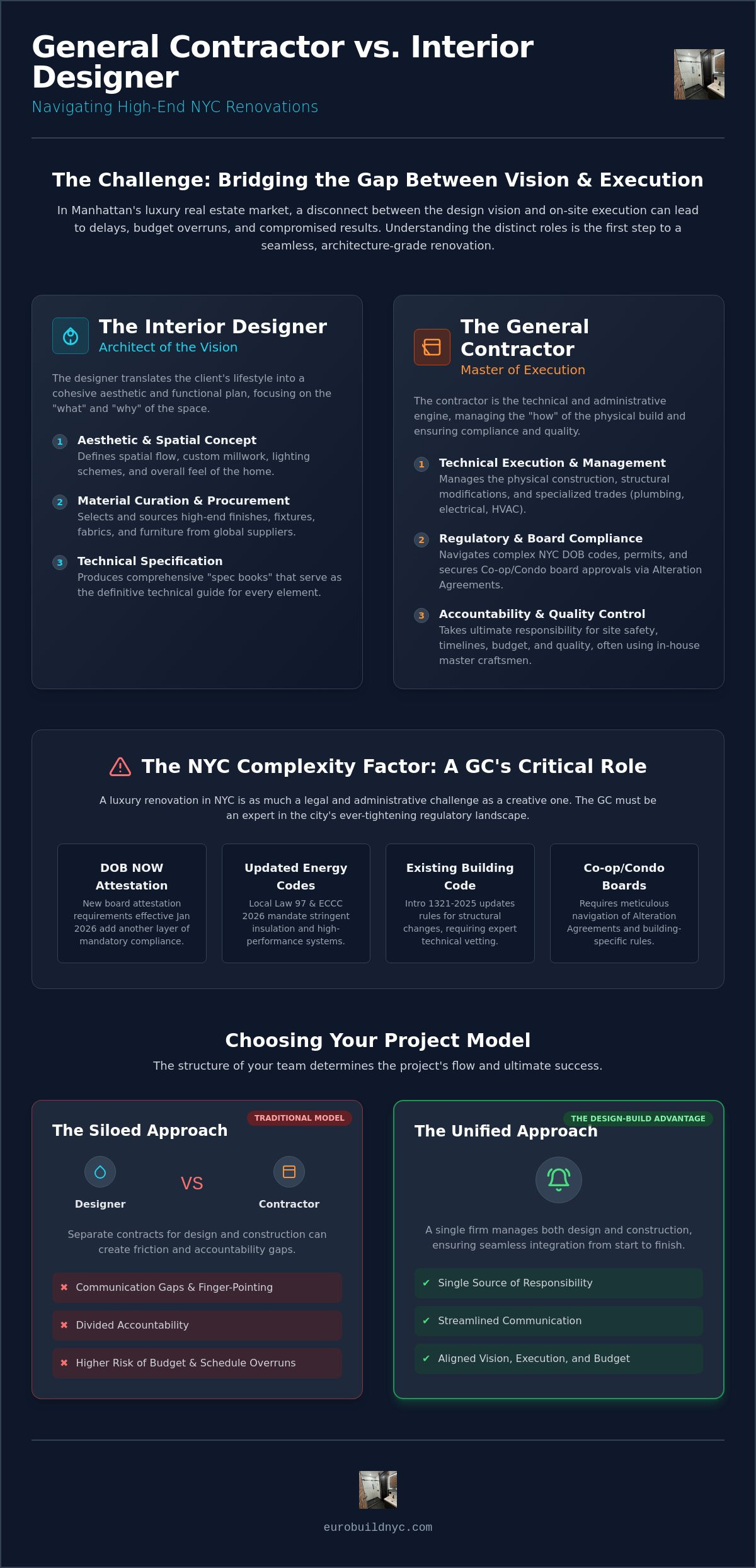
Distinguishing between a general contractor vs interior designer nyc is not merely an academic exercise. It is a prerequisite for project success. In the traditional Design-Bid-Build model, these professionals often operate in silos. One creates the dream; the other builds the reality. This separation frequently breeds friction, leading to cost overruns and compromised aesthetics. By 2026, the NYC luxury sector has shifted decisively toward integrated project delivery. Discerning clients now demand a unified approach where vision and execution are synchronized from the initial consultation.
The Interior Designer’s Scope: Beyond Aesthetics
An interior designer serves as the architect of the human experience within a home. Their work involves Defining Interior Design through spatial flow, custom millwork elevations, and meticulously curated lighting schemes. They are responsible for concept development and the procurement of high-end materials from global showrooms. Beyond selecting color palettes, they produce comprehensive "spec books." These documents serve as the definitive technical guide for every finish, fixture, and fabric. This role ensures that the aesthetic vision remains cohesive throughout an entire apartment renovation, balancing the client's lifestyle needs with sophisticated design principles.
The General Contractor’s Scope: Management and Compliance
The general contractor acts as the technical engine and administrative lead of the physical build. While the designer specifies the "what," the contractor manages the "how." This involves the technical execution of architectural plans and structural modifications. A critical distinction in the 2026 market is the use of in-house master craftsmen. Many firms rely exclusively on unknown subcontractors, which can lead to diluted quality. A premium contractor utilizes in-house master carpenters and tile setters to ensure that the precision of the design is matched by the precision of the installation. Their scope includes:
Trade Coordination: Managing specialized trades including electrical, plumbing, and high-performance HVAC systems.
Administrative Oversight: Taking ultimate accountability for site safety, insurance, and construction timelines.
Regulatory Compliance: Navigating the rigorous 2026 NYC Department of Buildings (DOB) codes and specialized Co-op board requirements.
Execution requires more than just labor. It requires management precision. The general contractor interprets the designer's vision for the reality of a Manhattan job site. They manage the logistics of moving custom European stone into a high-rise unit. They ensure that the structural integrity of a pre-war building is preserved during a complex gut renovation. This high-level technical mastery allows the interior designer to focus on the nuances of the client's aesthetic without getting bogged down in the minutiae of DOB filings or mechanical interference.
The NYC Complexity Factor: Regulatory Compliance and Board Approvals
In the vertical labyrinth of New York City, a luxury renovation is as much a legal undertaking as it is a creative one. The distinction between a general contractor vs interior designer nyc becomes sharpest when facing the Department of Buildings (DOB). As of 2026, the regulatory climate has tightened considerably. New mandates, such as the DOB NOW board attestation required since January 26, 2026, mean your contractor must be an administrative expert. While a designer focuses on the interior volume, the GC ensures that every structural change complies with Intro 1321-2025, the updated Existing Building Code.
Energy efficiency is no longer optional for high-end residences. Local Law 97 and the updated State Energy Conservation Construction Code (ECCC) effective January 2026 dictate stringent insulation values and HVAC specifications. A designer might envision a specific floor-to-ceiling glass wall, but the GC must verify it meets the 2026 window performance standards. This technical vetting prevents costly delays during the permit phase. Ensuring your partner meets all NYC Contractor Licensing Requirements is merely the starting point for navigating these hurdles.
Co-op and Condo Board Navigation
Success in a Manhattan high-rise depends on the Alteration Agreement. This document is the GC’s roadmap for building compliance. It outlines everything from permissible work hours to specific plumbing manifold requirements. Designers and GCs must collaborate early on "Protection Plans" for common areas. This isn't just about plywood in the elevators; it's about protecting the building’s liability. A seasoned GC manages the relationship with the Resident Manager or "Super," ensuring that the technical reality of the design doesn't clash with the building's infrastructure.
DOB and LPC Filing Strategies
Historic Manhattan townhouses add another layer of scrutiny through the Landmarks Preservation Commission (LPC). Here, the GC translates the designer’s vision into "As-Built" drawings that satisfy historic preservation standards. For those embarking on a comprehensive gut renovation nyc, technical filing precision is the only way to avoid stop-work orders. An integrated review process allows for expedited permits by resolving mechanical conflicts before they reach the examiner’s desk. If you are planning a complex transformation, consulting with an expert firm that understands these nuances can save months of administrative deadlock.
Core Differences in Management, Procurement, and Accountability
In the context of high-end home renovations nyc, accountability is often the first casualty of a fragmented team. When you hire a separate general contractor vs interior designer nyc, you essentially create two distinct centers of gravity. The designer pushes for the aesthetic ideal while the contractor focuses on the structural and financial reality. Without a unified management structure, the gap between these two often leads to cost creep. Accountability becomes elusive. One party blames the drawings; the other blames the execution. This friction represents a luxury project’s greatest risk.
Financial Oversight and Budgeting
Designers typically design to a vision. They curate the Value of an Interior Designer by enhancing long-term property worth through superior spatial planning and finish selection. However, the GC must align these choices with the construction budget. This alignment occurs during the "Value Engineering" phase. It is a delicate process. It requires transparency in change orders and meticulous tracking of luxury finish procurement. When procurement logistics from European showrooms meet the reality of a Manhattan job site, the GC’s ability to manage lead times becomes paramount. A failure in logistics management quickly translates into expensive site delays.
The Quality of Execution
Quality is not accidental. It is managed. Most general contractors rely on a rotating roster of subcontractors, which introduces unnecessary variability into the work. In contrast, utilizing in-house master craftsmen ensures a consistent, architecture-grade standard of excellence. Master carpenters and tile setters who work together daily understand the exacting tolerances required for high-end finishes. They don't just follow instructions; they take ownership of the result. For those vetting nyc apartment renovation contractors, the presence of in-house labor is often the deciding factor in achieving a flawless finish.
The designer’s role eventually shifts to "Punch List" management. They provide the final aesthetic approval, ensuring the physical result matches the original spec book. This final check ensures that the structural integrity managed by the GC meets the aesthetic vision of the designer. By integrating these roles, you remove the "blame game" and replace it with a culture of single-source responsibility. The result is a home that matches your high-end vision without the stress of mismanaged expectations.
Strategic Selection: When to Hire a Designer, a GC, or a Design-Build Firm
Traditional advice often suggests hiring a designer to create a vision before bidding the work out to multiple contractors. In the 2026 NYC market, this fragmented approach is a liability. It often results in beautiful designs that are either structurally impossible or financially ruinous. Choosing between a general contractor vs interior designer nyc depends entirely on the technical and aesthetic depth of your project. You must align your professional team with the specific complexities of your residence.
For cosmetic updates involving only paint, window treatments, and furniture, a standalone designer is sufficient. Conversely, when the focus is purely on mechanical upgrades or minor structural repairs, a general contractor can lead the project effectively. However, for comprehensive luxury transformations, the design-build model provides the single point of contact necessary to manage Manhattan’s unique regulatory and logistical pressures. This model removes the friction of separate contracts, replacing it with a unified culture of accountability.
Assessing Your Project Scope
The first step is distinguishing between a "refresh" and a "gut renovation." A refresh might only require aesthetic guidance. A gut renovation requires senior-level oversight of every trade and structural element. Complex projects, such as an nyc apartment combination, demand a sophisticated understanding of structural integration that goes far beyond surface-level design. You must determine the level of structural intervention early. This prevents administrative deadlock with your Co-op board and ensures your project remains viable from day one.
The 3-Step Selection Framework
Step 1: Define your primary goal. Determine if your priority is the aesthetic experience, structural integrity, or a turnkey, stress-free result. A design-build firm is the standard for the latter.
Step 2: Review portfolios for NYC co-op experience. High-end work in Manhattan requires specific knowledge of building-specific alteration agreements and resident manager relations.
Step 3: Interview for accountability. Ask specifically who takes ownership if a design element conflicts with a site condition. Look for firms that utilize in-house master craftsmen rather than a rotating roster of unknown subcontractors.
For those seeking a seamless transition from vision to reality, contacting a design-build expert ensures your project is handled with master-level precision and single-source responsibility. This approach protects your time as much as your investment.
The Design-Build Advantage: Single-Source Responsibility for NYC Residences
The friction between a general contractor vs interior designer nyc often stems from misaligned incentives. One professional manages the dream while the other manages the dirt. In a traditional model, the client acts as the involuntary mediator between these two worlds. This creates unnecessary stress and technical gaps. The design-build model solves this by merging these disciplines into a single, cohesive entity. It replaces finger-pointing with a culture of ownership. Every detail, from the structural load-bearing wall to the hand-applied plaster finish, is managed under one roof. This integration ensures that the aesthetic intent is baked into the technical execution from day one.
Why One Point of Contact Changes Everything
Communication failures during the high-pressure construction phase are the primary cause of project delays. Having one point of contact changes the entire project dynamic. It streamlines decision-making when site conditions inevitably clash with design intent. You don't have to worry about who takes accountability for a measurement error or a procurement delay. Total accountability extends from the initial conceptual sketch to the final DOB sign-off. This turnkey approach provides a level of peace of mind that separate contracts simply cannot match. It allows the homeowner to remain the visionary while the firm handles the administrative and technical execution.
The Eurobuild Standard of Excellence
Interior Design & Building Inc operates as a Boutique Authority. We don't just manage projects; we master them. Our standard of excellence is built upon utilizing in-house master craftsmen. This is a critical distinction in a city where most firms rely on a revolving door of subcontractors. By employing our own master carpenters and tile setters, we maintain uncompromising quality control over every square foot of your residence. We navigate the complex interplay of NYC regulations and high-end design with the confidence of seasoned experts. Our senior-level oversight ensures that no detail is overlooked during the transition from drawing to reality.
Our methodology ensures that administrative compliance is never sacrificed for aesthetic vision. We handle the 2026 energy code mandates and Co-op board negotiations with precision. This integrated approach removes the burden of project management from your shoulders. You deserve a partner who takes full ownership of the result. Discover how our integrated design-build approach elevates your NYC home renovation and provides the architecture-grade results your home deserves.
Securing the Future of Your Manhattan Residence
The choice between a general contractor vs interior designer nyc ultimately determines the level of risk you're willing to accept. Fragmented teams often lead to communication gaps that compromise both the timeline and the final aesthetic. By opting for a design-build model, you eliminate the friction between vision and execution. You replace the stress of multi-party coordination with the assurance of single-source responsibility. This approach ensures that your home meets the rigorous 2026 DOB standards without sacrificing a single detail of your design intent.
Our boutique firm specializes in this seamless integration. We utilize in-house master craftsmen to provide superior quality control and management precision. We offer comprehensive oversight of NYC board and DOB approvals to remove administrative burdens from your shoulders. This dedicated accountability protects your investment and your time. It's about more than just building a space; it's about delivering a turnkey experience that matches the luxury of the results. Your vision deserves the precision of a master builder and the soul of a designer.
Consult with our NYC Design-Build Experts today to begin your transformation with total confidence. Let's create a home that stands as a testament to uncompromising standards and sophisticated design.
Frequently Asked Questions
Do I need an architect if I hire an interior designer in NYC?
You generally need a Registered Architect for any project involving structural modifications or Department of Buildings filings. While an interior designer curates the aesthetic volume, they cannot legally sign off on technical drawings required by NYC law. Hiring a firm that integrates these disciplines ensures your design intent is technically viable from the start, preventing administrative delays during the permitting phase.
Who handles the Co-op board approval, the designer or the contractor?
The general contractor typically takes the lead on Co-op board approvals by acting as the primary liaison with the Resident Manager or "Super." They ensure the technical details of the designer's vision comply with the building's specific Alteration Agreement. This coordination is critical for securing the board's attestation in the DOB NOW system, a requirement that became mandatory in early 2026.
Is it more expensive to hire a design-build firm than hiring separately?
It isn't necessarily more expensive. While the initial fee reflects a comprehensive service, design-build reduces "cost creep" by aligning the general contractor vs interior designer nyc from the outset. Separate entities often lead to expensive change orders when the builder discovers the designer's plans are structurally difficult to execute. Efficiency and single-source accountability usually lead to a more predictable final investment.
Can a general contractor do interior design?
Most general contractors focus strictly on technical execution and management precision rather than spatial aesthetics. While some may offer basic layout advice, they lack the specialized training in material procurement and lighting design that a professional designer provides. To achieve an architecture-grade result, it's better to partner with a boutique firm that treats design and craftsmanship as equal priorities.
How long does a luxury apartment renovation typically take in Manhattan?
A luxury apartment renovation in Manhattan typically requires six to twelve months from the initial design phase to the final punch list. This timeline accounts for the three to four months often needed for Co-op board reviews and DOB permit approvals. More complex projects involving structural changes or custom global procurement can extend this duration, particularly in historic or landmarked buildings.
What happens if the designer’s plans cannot be built as drawn?
In a traditional model, unbuildable plans lead to a "blame game" where the client pays for the resulting delays. If you utilize a design-build approach, the firm takes full ownership of the conflict. Because the builders and designers work on the same team, they resolve technical discrepancies internally. This ensures the final result remains true to your vision without additional financial burden.
Does Interior Design & Building Inc work with outside architects?
We frequently collaborate with outside architects and independent designers while providing the master-level craftsmanship and project management required for execution. Our team acts as the technical engine that brings external visions to life. We ensure every detail meets our rigorous standards for quality and compliance, providing a single point of contact for the duration of the build.
What insurance should my NYC contractor carry for a luxury renovation?
Your contractor must carry comprehensive General Liability, Workers' Compensation, and high-limit Umbrella insurance. In NYC's high-stakes luxury market, these policies must specifically cover the complexities of high-rise residential work. We maintain senior-level oversight of all insurance documentation to protect our clients from liability and ensure full compliance with the most stringent Co-op board requirements.


Comments